
What is the Museum’s Living Terrace like?
Total surface area of the roof: 14,000 m2. Surface area of the Living Terrace: 7,100 m2.
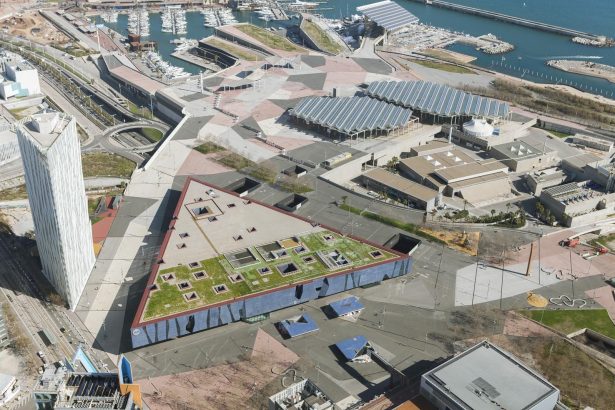
Aerial view of the green roof of the Museum. Image of Pere Vivas/MCNB
Specific building features and location are factors that determine the types of plants that can be grown on green roofs. As to the Museum’s Living Terrace, it has a weight limit, the sea is nearby, and it is often windy. So as not to exceed the maximum weight of the roof, herbaceous plants were chosen, as they only require a thin layer of soil. Trees and heavy plants were therefore avoided.
The Living Terrace houses vegetation that has adapted to the environmental conditions of the Mediterranean and specifically to those of Barcelona and the proximity to the sea.
The Museum’s Living Terrace is a natural laboratory where scientific research can be carried out in various fields. Its specific features allow for studies on fauna, water quality, or climate change in a controlled environment.
These projects are developed by the Museum’s scientific teams in collaboration with other research centers and universities.
What can you find on the Living Terrace?
1. Mesocosms
To understand how ecosystems respond to environmental changes, they must be subjected to the same pressures they will face in the real world. One good indicator is the soil microbiome. To study this in a controlled way, we use mesocosms: small greenhouse structures shaped like open-top hexagonal domes. These structures keep the internal temperature 2 °C warmer than the outside to simulate the predicted effects of climate change.
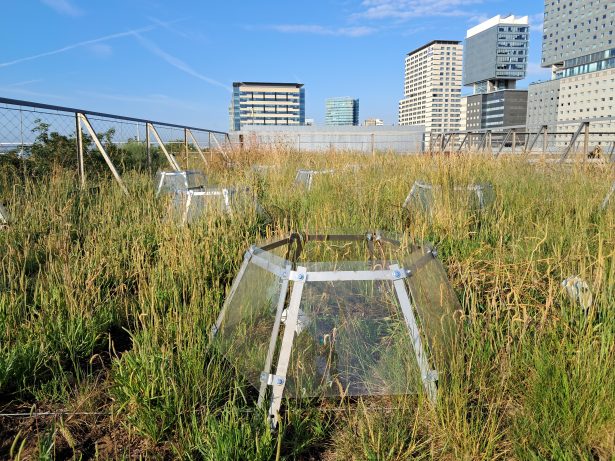
Mesocosmos. Imatge de Cristina Serradell/MCNB
We study how microbial communities change both inside and outside the mesocosms to identify early warning signs. This allows us to anticipate possible tipping points and better understand ecological limits before changes become irreversible. This shows us that small variations can cause major changes in how ecosystems function.
Mesocosms is a project led by the Complex Systems Laboratory (Universitat Pompeu Fabra), the Arid Lands and Global Change Laboratory (Universitat d’Alacant), and the Natural Sciences Museum of Barcelona. It is one of the winning proposals of the research and innovation grant call promoted by the Ajuntament de Barcelona and the Fundació “la Caixa”.
2. Mediterranean meadows
These consist of annual plants that survive the summer heat in the form of seeds when the plant dries out or as underground bulbs waiting for better conditions to sprout again. They are well adapted to the coastal environment and provide benefits to the urban environment, the building, and human health.
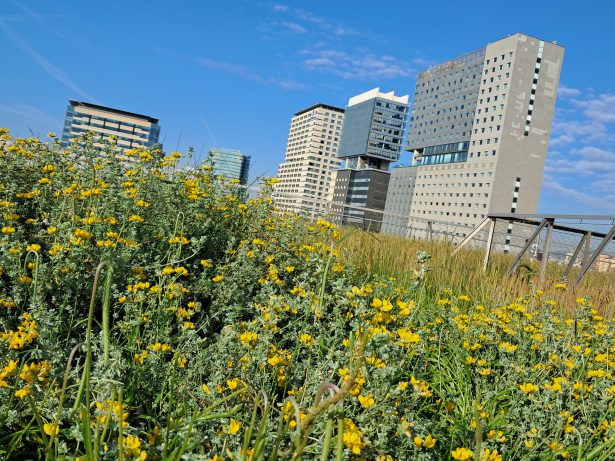
Prats mediterrains Terrat Viu. Imatge de Cristina Serradell/MCNB
3. Freshwater ponds
These ponds contain plants adapted to Barcelona’s water and climate conditions. They provide a habitat for many small and large animals that help maintain a balanced and self-sustaining natural environment.
4. Insect hotel and nectar-producing plants
These attract pollinating insects and help conserve solitary bees and wasps, which are essential for maintaining the balance of natural ecosystems.
5. The Garden of the World’s Mediterranean Regions
This is a small sample of plants from the Jardí Botànic de Barcelona (Botanical Garden of Barcelona), dedicated to Mediterranean flora from around the world. In addition to the Mediterranean Basin, this type of climate is also found in parts of Chile, Australia, California, and South Africa.
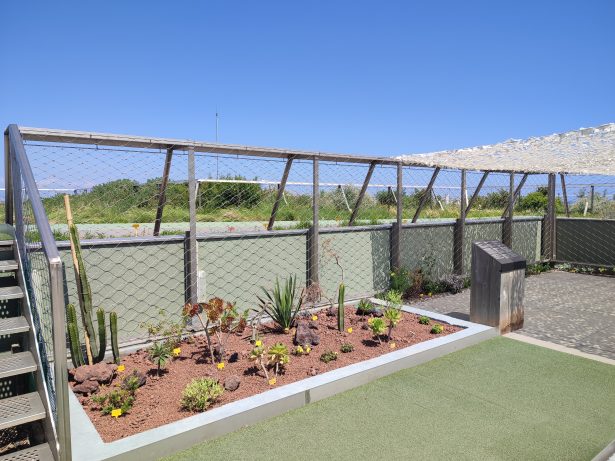
Imatge de Clara González/MCNB
Practical Information
October to February:
Weekends and public holidays, from 11 a.m. to 3 p.m.
March to September:
Saturdays, from 11 a.m. to 3 p.m.
Sundays and public holidays, from 11 a.m. to 3 p.m.
Sunday afternoons (free entry), from 4 p.m. to 8 p.m.
Admission is included with the Museum’s general entry.