
The Museu de Ciències Naturals de Barcelona (MCNB) is the protagonist of a new contribution to paleontological research: a fossil preserved in its reserve (MGB V60), from the site of Sant Miquel de Toudell (Viladecavalls), has been key to describing a new genus and species of legless lizard, Fontisaurus tarumbaire. The study, led by the Institut Català de Paleontologia Miquel Crusafont (ICP-CERCA) and published in the Swiss Journal of Palaeontology, highlights the importance of scientific collections as a source of new knowledge.
This specimen is part of the J.F. de Villalta paleontological collection, donated to the Museum in 1983 and considered one of the most valuable due to its volume, state of conservation and scientific relevance. With more than 32,000 record units and about 106,000 specimens, the collection is the result of fifty years of dedication by Josep Fernández de Villalta, a CSIC researcher and professor of several generations of geologists at the University of Barcelona.
The value of collections and their preservation work
According to Vicent Vicedo, curator of the Museum’s paleontology collection, “the fact that a specimen preserved for decades has allowed a new species to be described is a demonstration of the essential role of scientific collections. They are an archive of the past of incalculable value, a living heritage at the service of research.” Vicedo also underlines the importance of natural heritage management as a public service: “Conserving, documenting and facilitating access to materials for current and future research is a central responsibility of the institution. Our work is part of a continuous line that unites research, heritage and knowledge shared with society.”
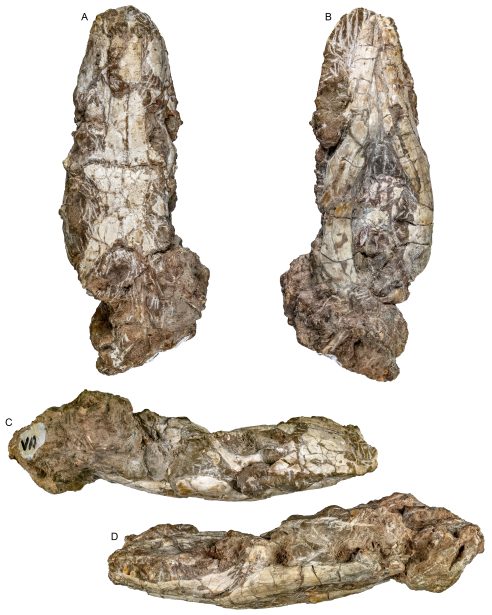
Original fossil skull of the new anguid Fontisaurus tarumbaire. The specimen is presented from different angles (A–D) to show all the preserved details. Credit: Villa et al., 2025
Describing a new species from a fossil automatically transforms it into a holotype, i.e. the reference fossil specimen on which a species is scientifically described. It serves as a permanent standard for identifying and comparing other remains and is essential for ensuring the stability of scientific nomenclature. With the incorporation of Fontisaurus tarumbaire, the MCNB’s paleontology collection has 2,034 name-type specimens (holotypes, syntypes, neotypes and lectotypes), corresponding to species of vertebrates, invertebrates, plants and protozoa, a testimony to the great diversity and richness of the natural heritage.
A new Miocene lizard
Fontisaurus tarumbaire, described thanks to advanced imaging techniques such as neutron tomography, represents a different evolutionary line within the group of anguids, reptiles related to today’s common slow worm. During their evolutionary history, they have both lost their legs, which often causes them to be mistaken for snakes. The study has been possible, among other factors, thanks to the excellent state of conservation of the fossil: a skull more than ten million years old with the bones joined together and in the same position as they were in life.
This discovery reinforces the idea that the diversity of these lizards in the European Miocene – a geological epoch that took place between approximately 23 and 5 million years ago – was much greater than previously thought.
In this case, the name has been chosen through a participatory initiative promoted by the ICP, in which the citizens of Viladecavalls, where the fossil was found, were able to vote among several proposals. The genus, Fontisaurus, refers to a local legend that attributes to each fountain in the municipality the protection of a small dragon, while tarumbaire alludes to the popular name of the inhabitants of Viladecavalls.
Scientific reference article: Villa, A., Bolet, A., Klembara, J. et al. A new anguine lizard (Squamata, Anguidae, Anguinae) from the Late Miocene (Vallesian) of the Vallès-Penedès Basin (NE Iberian Peninsula). Swiss J Palaeontol 144, 70 (2025). https://doi.org/10.1186/s13358-025-00411-3
News adapted from the ICP press release: A new fossil lizard from Viladecavalls is named with the participation of local residents (link)