
In an era of open science and major environmental challenges, scientific journals are fundamental vehicles for generating, validating and disseminating scientific knowledge. They connect the global research community, ensure the quality of scientific content through peer review, and enable scientific advances to reach experts, managers, and policymakers alike.
One of the most widely used indicators for assessing the relevance of a journal is the Journal Impact Factor (JIF) reported by Journal Citation Reports (JCR), which measures the frequency with which articles published in a journal are cited in other scientific publications. While it is not the only method of evaluation and sometimes raises questions of bias, it remains a key reference for positioning journals in an international context and assessing their influence in respective fields of knowledge.
At a time when the conservation of biodiversity is more pressing than ever, the Museum’s journal Animal Biodiversity and Conservation (ABC) has become established as one of the leading natural sciences publications in the country.
With an impact factor of 1.4 and its position in the third quartile (Q3) of international conservation journals (recently evaluated by Clarivate Analytics for 2024), the ABC journal has proved itself outstanding in the competitive landscape of Spanish journals dedicated to nature and conservation. In a recent analysis of national publications related to the natural sciences, ABC has ranked among the leading Spanish scientific journals over just a few years of evaluation, alongside prestigious journals such as Limnetica, Ardeola, Scientia Marina and Thalassas, reinforcing its role as a platform for quality research on biodiversity, zoology, ecology and evolutionary biology (Figure 1).
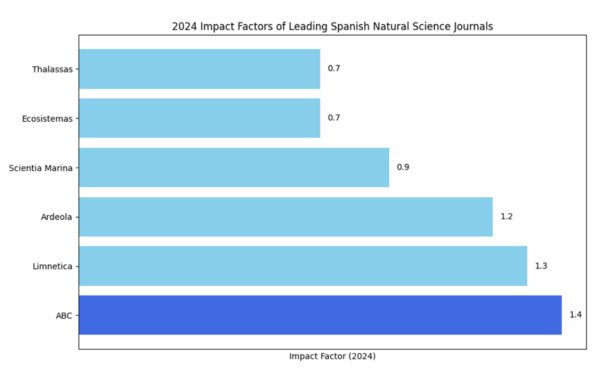
Figure 1. JCR impact index comparison for Spanish natural science journals (2025 data from Web of Science – Life Sciences & Biomedicine).
The impact of the ABC journal has been growing steadily, and this year its significance has been widely recognised (Figure 2). Key to this development is that it is published as a fully open access journal. Today, many scientific journals are open access for readers, but are costly for contributing authors who must pay considerable article processing charges (APCs) to publish their work. These charges can amount to €1,000–€10,000 per article, effectively functioning as a barrier to the research community, especially for those working in countries or centres with limited resources. At the same time, many other journals restrict access to their content through paywalls – charging readers rather than authors – and thus hinder the dissemination of scientific knowledge.
On the other hand, the Museum’s scientific journal ABC follows the Diamond Open Access model: there are no fees for publishing authors or for readers to access the articles. And this is possible because the journal is supported by a public institution, in this case the Museum. This ensures that science is accessible to all, without economic barriers for researchers or readers, and makes the journal an essential resource in giving international visibility to biodiversity research carried out in Catalonia, Spain and the Mediterranean, in alignment with the mission of the Museum of Natural Sciences of Barcelona.
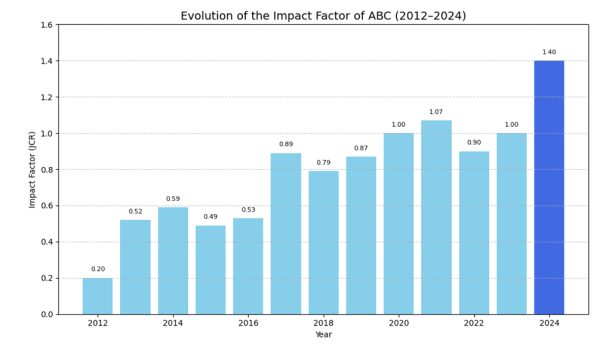
Figure 2. Evolution of the JCR Journal Impact Factor for the journal Animal Biodiversity and Conservation (2012–2024) (2025 data from Web of Science).
A journal with a promising future
At a time when science and conservation need strong allies, Animal Biodiversity and Conservation is more than just a scientific journal: it is a strategic asset, because of its potential to raise the Museum’s profile as a leading scientific institution. This is especially valuable in a global context in which scientific institutions are competing for visibility, impact and leadership. Moreover, publishing ABC as a fully open access journal aligns with the Museum’s values: to democratise scientific knowledge, promote open science, and support the scientific community, in its mission to research, discuss, communicate and protect biodiversity.
Joan Carles Senar; Ian Macgregor-Fors; Javier Quesada; Berta Caballero
Editor-in-Chief of the Museum’s Scientific Journals